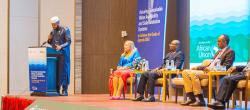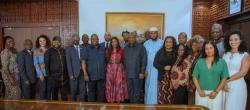



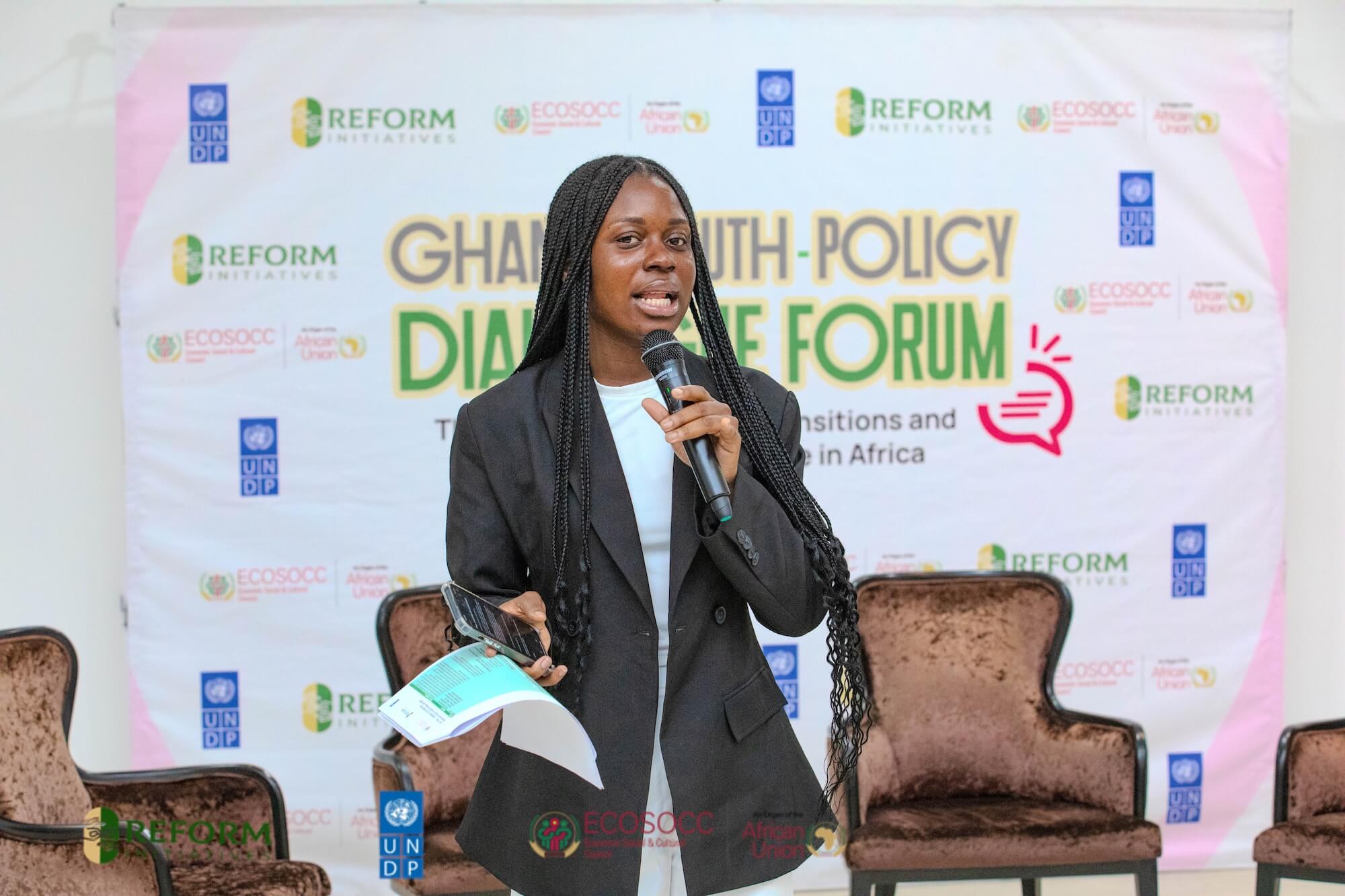
Accra, Ghana, 22 October 2026 – The Ghana Youth Policy Dialogue Forum opened yesterday with a call to move young Africans from consultation and digital mobilisation to direct influence over policies, public institutions and democratic decision-making.
Organised by the African Union Economic, Social and Cultural Council (AU-ECOSOCC) and Reform Initiatives (RI), with support from the United Nations Development Programme (UNDP), the three-day forum is being held under the theme “Gen Z, Political Transitions and the Future of Governance in Africa: From Youth Mobilisation to Institutional Influence.”
Opening discussions examined why young people increasingly demand responsive institutions, decent livelihoods and genuine opportunities to shape governance. Speakers called for practical civic skills, stronger implementation of existing African Union commitments, and pathways connecting youth-led mobilisation to policy action.
Mr.Kyeretwie Akwasi Osei, Head of Programmes, ECOSOCC, highlighted the African Youth Charter, the African Charter on Democracy, Elections and Governance, the AU Youth Envoy and the African Union Youth Volunteer Corps as existing instruments and opportunities for youth engagement. He urged young people to learn what Member States have committed to and use those obligations to demand accountability. Noting the many continental plans and strategies already adopted, he stressed that “the problem has been implementation.”
Mr. Makmid Kamara, Executive Director of Reform Initiatives, explained that the meeting was organised to draw on participants’ ideas and solutions: “We are actually here to harvest the solutions that we know you have.” He highlighted the Creative Democracy Lab and the Democracy Innovations Café as opportunities to reimagine democracy through creative and institutional approaches and noted that related dialogues would continue in Sierra Leone.
Mr. Stephen Caleb Opuni, Regional Director of the Africa IDP Foundation and member of the ECOSOCC Ghana National Chapter, urged deliberate investment in education and skills development so Africa’s young population can assume leadership responsibilities. He challenged participants to consider young people outside established, often urban, policy spaces, build solidarity beyond the room and offer practical solutions: “Let’s not only challenge. Let’s also offer alternatives.”
Ms.Mona Iddrisu, Head of Youth Employment and Skills at the African Center for Economic Transformation (ACET), explained that the ability to engage effectively in policy processes is itself a skill. Drawing on ACET’s Youth Policy Lab, she called for young people to become active participants in designing systems, rather than merely their beneficiaries. Referring to ACET research across 22 African countries, she also urged policymakers to move beyond
employment totals and confront the quality of jobs, including inadequate social protection, maternity leave and working conditions.
Dr Edward Amptratwum, Head of Cluster, Transformative Governance, UNDP Ghana, speaking on behalf of the UNDP Country Representative, underscored that young people are not merely seeking consultation: they want meaningful influence over decisions affecting their lives. He challenged institutions to adapt to new forms of participation through digital platforms, civic movements and social action. Citing Afrobarometer findings discussed in his remarks, he noted the contrast between young people’s support for democracy and dissatisfaction with its performance, and linked democratic legitimacy to access to skills, technology, finance, markets and decent livelihoods. He encouraged youth engagement in Ghana’s constitutional reform discussions and highlighted UNDP initiatives in innovation, enterprise and peacebuilding. He subsequently formally declared the Forum open on behalf of UNDP leadership.
Mr. Sixtus Dong Ullo, legal practitioner, broadcast journalist and communications specialist, demonstrated how social media has transformed who can start public conversations and mobilise civic action. Contrasting earlier dependence on town criers and national broadcasters with today’s X, TikTok and Facebook networks, he cited Nigeria’s #EndSARS mobilisation and challenged young people to use their digital influence purposefully for accountability, not only entertainment.
In a special presentation, data artist, Ms. Whitney Ernest used “Witnessing Democracy” to show how artistic visualisation can make complex governance histories accessible. Her artwork traced political systems across Africa’s 55 countries, including military rule, one-party governance, multiparty systems and unconstitutional changes of government.
She urged participants to consider examples of democratic progress, including Botswana, and spoke about “democratizing knowledge” through creative formats that invite curiosity, interpretation and discussion.
The dialogue takes place in the 20th anniversary year of the African Youth Charter, alongside continued efforts to advance the African Charter on Democracy, Elections and Governance and Agenda 2063. Ghana’s discussions on constitutional reform also provide a timely national setting for examining how young people can contribute to institutional renewal.
The Forum seeks to generate practical youth-led proposals on policy participation, institutional trust, digital accountability and political transitions. The dialogue also contributes to ECOSOCC and Reform Initiatives Gen Z Democracy Accelerator and complements their work on reimagining a just and resilient democracy in Africa. The opening exchanges reinforced a shared challenge: to turn young peoples’ demonstrated civic energy into sustained influence over the institutions that shape their futures.
#
About the Organisers
The African Union Economic, Social and Cultural Council (AU-ECOSOCC) is an advisory and consultative organ of the African Union that provides a platform for civil society organisations to contribute to the Union’s policies, programmes and principles.
Reform Initiatives (RI) is an independent, multi-thematic, non-partisan Pan-African research, policy and advocacy institution working to advance reparatory justice, democracy and governance, transitional justice and human rights.