

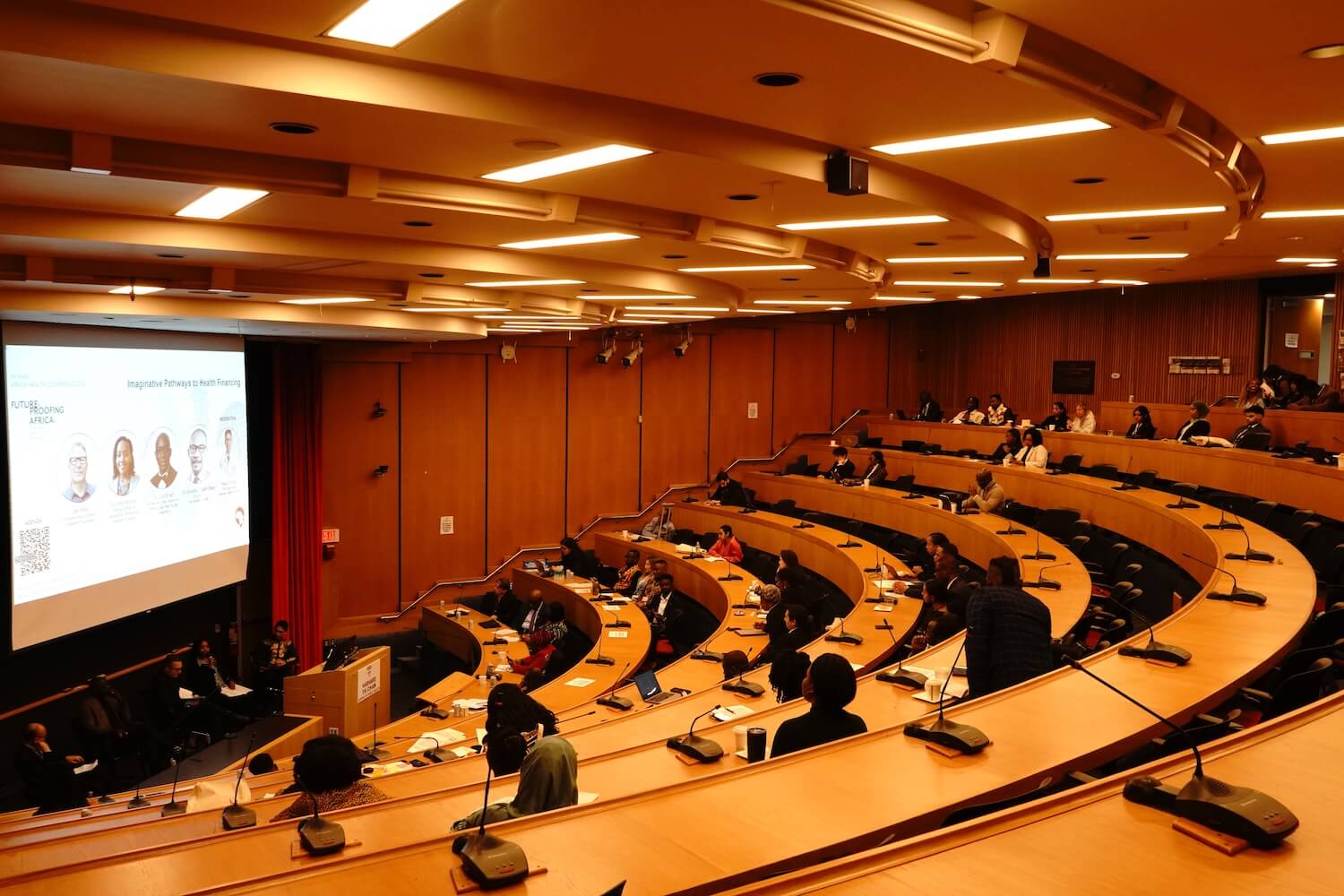
As the doors of the Harvard T.H. Chan School of Public Health opened on February 21, 2026, for the Africa Health Conference 2026, it was clear that this year’s event would be nothing short of transformative. The theme, "Future-Proofing Africa: Investing in Impact and Innovation," set the tone for a gathering that brought together global health researchers, policymakers, entrepreneurs, and students from across the world to focus on solutions to Africa’s evolving health challenges.
The day began with a warm welcome from the conference co-chairs, Ngasuma Kanyeka, a doctoral candidate at Harvard T.H. Chan School of Public Health, and Krystal Lwanga, a student at Harvard Dental School, setting the stage for a dynamic program that blended academic insight, policy dialogue, and innovation-driven conversations focused on Africa’s health future.
An early highlight of the conference was a fireside chat titled “Grounding in Reality,” featuring Professor Stéphane Verguet, Associate Professor of Global Health at Harvard T.H. Chan School of Public Health, and Dr. Victor Bampoe, Chief Executive Officer of the National Health Insurance Authority of Ghana. Their conversation explored the evolving landscape of health systems across the continent, with Dr. Bampoe sharing Ghana’s progress in expanding access to care through national health insurance programs. His insights underscored the critical role that sustainable financing mechanisms and government-led insurance models will play in strengthening Africa’s health systems and ensuring long-term access to care.
The discussion was followed by remarks from Professor Stéphane Verguet, who reflected on the importance of bridging rigorous academic research with real-world public health challenges across Africa.
The conference then moved into its official opening with remarks from Honourable Emma Inamutila Theofelus, Member of Parliament and Minister of Information and Communication Technology of the Republic of Namibia. Speaking passionately about youth leadership and governance, Minister Theofelus emphasized the importance of empowering the next generation of African leaders to shape policy and drive sustainable development across the continent. In her remarks, she asked the audience, “How do you make a dent in the systems you operate in?” sparking a conversation on the systemic changes the continent needs to create prosperity for its people.
The first panel discussion, “Imaginative Pathways to Health Financing,” moderated by Faraan Rahim, a medical student from Harvard Medical School, brought together leading voices in global health finance. Panelists included Lee Wells, Global Director of m-mama at the Vodafone Foundation; Ruvimbo Mushavi, Program Officer for International Partnerships at the Wagner Foundation; Dr. Carl Smart, Partner and Chief Investment Officer at Black Pearl Global Investments; and Dr. Muhamad Chatib Basri, Co-Chair of The Pandemic Fund. Their discussion explored innovative approaches to health financing, emphasizing new partnerships between governments, philanthropic institutions, and private sector actors to unlock sustainable funding for Africa’s health systems.
Later in the morning, a second fireside chat moderated by Ngasuma Kanyeka featured Honourable Emma Inamutila Theofelus, focusing on leadership, governance, and designing technology that centers people’s wellbeing. While AI is becoming increasingly important, the Minister urged conference participants to ground their solutions in the realities of African people. The discussion explored how emerging African leaders can shape inclusive policy frameworks and bring fresh perspectives to public sector leadership, particularly in areas such as health, technology, and economic transformation.
The afternoon sessions highlighted the importance of women’s leadership in health systems through the African Women in Leadership (AWL) segment. Dr. Ruth L. Okediji, Jeremiah Smith, Jr. Professor of Law at Harvard Law School, delivered opening remarks emphasizing the role of women as architects of innovation and change in global health governance. This was followed by a fireside conversation with Dr. Abigail Arthur, Postdoctoral Research Fellow at UMass Chan Medical School, who reflected on the growing impact of women leaders in advancing health research, policy, and community engagement across the continent.
Another key highlight of the day was Panel 2: “Innovation for Impact: Future-Proofing African Health,” moderated by Xiao Wei Yeap. The panel featured Dr. Tosin Omole, Senior Director of Vaccine Global Medical Affairs at Merck; Nikhil Pereira-Kamath, Co-Founder and Chairman of Africa Healthcare Network; Ryan Fu, Global Innovation Lead at Clinton Health Access Initiative; and Dr. Lia Tadesse Gebremedhin, Executive Director of the Harvard Ministerial Leadership Program and former Minister of Health of Ethiopia. The discussion focused on how innovation—whether in digital health technologies, pharmaceutical manufacturing, or community health initiatives—is reshaping Africa’s healthcare landscape. The panelists highlighted the importance of scaling locally developed solutions that respond directly to the realities of African health systems.
Kgosietsile II Matthews Mmopi, Partner at McKinsey & Company and Leader of McKinsey’s Social, Healthcare and Public Sector Practice in Africa and Life Sciences Practice in Eastern Europe, the Middle East, and Africa, led an ideation session with over 35 select participants. Moderated by Papa Freduah Anderson and Xiao Yeap, this hands-on, workshop-style session was one of the highlights of the conference, as participants had the opportunity to test ideas and solutions.
Throughout the day, the conference also showcased emerging research through poster presentations from scholars working on a wide range of global health issues, further reinforcing the role of academic research in shaping policy and practice.
As the conference drew to a close, Faraan Rahim and Krystal Lwanga welcomed the audience to the final session of the day: handing prizes to the scientific poster winners. The ceremony, graced by the closing keynote speaker Ambassador William Carew, Head of the Secretariat of the African Union Economic, Social and Cultural Council (ECOSOCC), added a sense of accomplishment for the winners who competed against 120 submissions, for 20 spots to show their work, and ultimately had three winners chosen.
The first prize was awarded to Bernard Ofosuhene for his poster titled “Benchmarking AI-Native Infrastructure for Decentralized Primary Care in Low-Resource African Terrains.”
Second prize went to Zoe Hughes, a Stanford Medical Student, who presented “Endowment-Backed Primary Care: An Innovative Financing Model at Twese Clinic in Burundi,” highlighting an innovation from Burundi designed by Eloi Mugabe Bigirimana of Twese Clinic, where a one-off US donation was invested in the U.S. stock market and the dividends were used to finance a community clinic and create a community health insurance program.
Third prize was awarded to Chelsea Imuetinyanosa Osayande for her research titled “A Digital Approach to Strengthening Immunization Workforce Capacity: Evidence from Cameroon’s EPI Coaching Hub.” This was one of the examples of innovative financing and digital health solutions designed to serve and strengthen African health systems.
The Closing Keynote Address was delivered by Ambassador William Carew, Head of the Secretariat of the African Union Economic, Social and Cultural Council (ECOSOCC). To welcome the closing keynote speaker, Ngasuma Kanyeka, one of the conference co-chairs, remarked on how dedicated leadership across the continent by leaders like Ambassador Carew is one of the key ways to future-proof the continent. “The continent needs leaders who are grounded in the realities of the continent and who are convicted by the urgency to solve its persistent challenges.”
In his powerful closing remarks, Ambassador Carew underscored the growing importance of African-led diplomacy in health governance. His message was clear: Africa is not waiting for permission to shape its health future. The continent is actively building the institutional architecture needed to lead its own health solutions.
He pointed to the establishment of the Africa Centres for Disease Control and Prevention (Africa CDC) and the African Medicines Agency (AMA) as landmark milestones demonstrating Africa’s increasing institutional maturity in global health governance. Ambassador Carew also reflected on the Africa CDC’s leadership during the COVID-19 pandemic and its declaration of the Mpox Public Health Emergency of Continental Security, emphasizing how African institutions are increasingly taking the lead in coordinating responses to public health threats.
Carew concluded with a call for stronger collaboration between institutions such as Harvard University and the African Union ECOSOCC, combining academic rigor with grassroots knowledge to advance sustainable health solutions across Africa.
For many attendees, the Africa Health Conference 2026 was more than just an intellectual gathering—it was a call to action. Ambassador Carew’s message, particularly to the young African leaders in the room, was not just about participating in global health conversations but about leading them.
The conference ultimately provided a renewed sense of purpose for all who attended, especially the young scholars, innovators, and policymakers already working to shape the continent’s health future. Ambassador Carew challenged them not to measure their success by external benchmarks, but by their ability to strengthen African health systems and advance health equity for the communities that nurtured them long before global institutions did.
In conclusion, Africa Health Conference 2026 was both a moment of reflection and a platform for action. It celebrated the resilience and innovation of Africa while highlighting the growing ecosystem of African-led solutions transforming health systems across the continent.
As the closing remarks echoed across the hall, one message stood clear: Africa is already moving, and the future of African health will be shaped by the leaders, researchers, and innovators who gathered that day at Harvard.
The future of African health is not just on the horizon—it is unfolding now, driven by a new generation committed to building a self-sustaining, innovative, and impact-driven health future for the continent.