
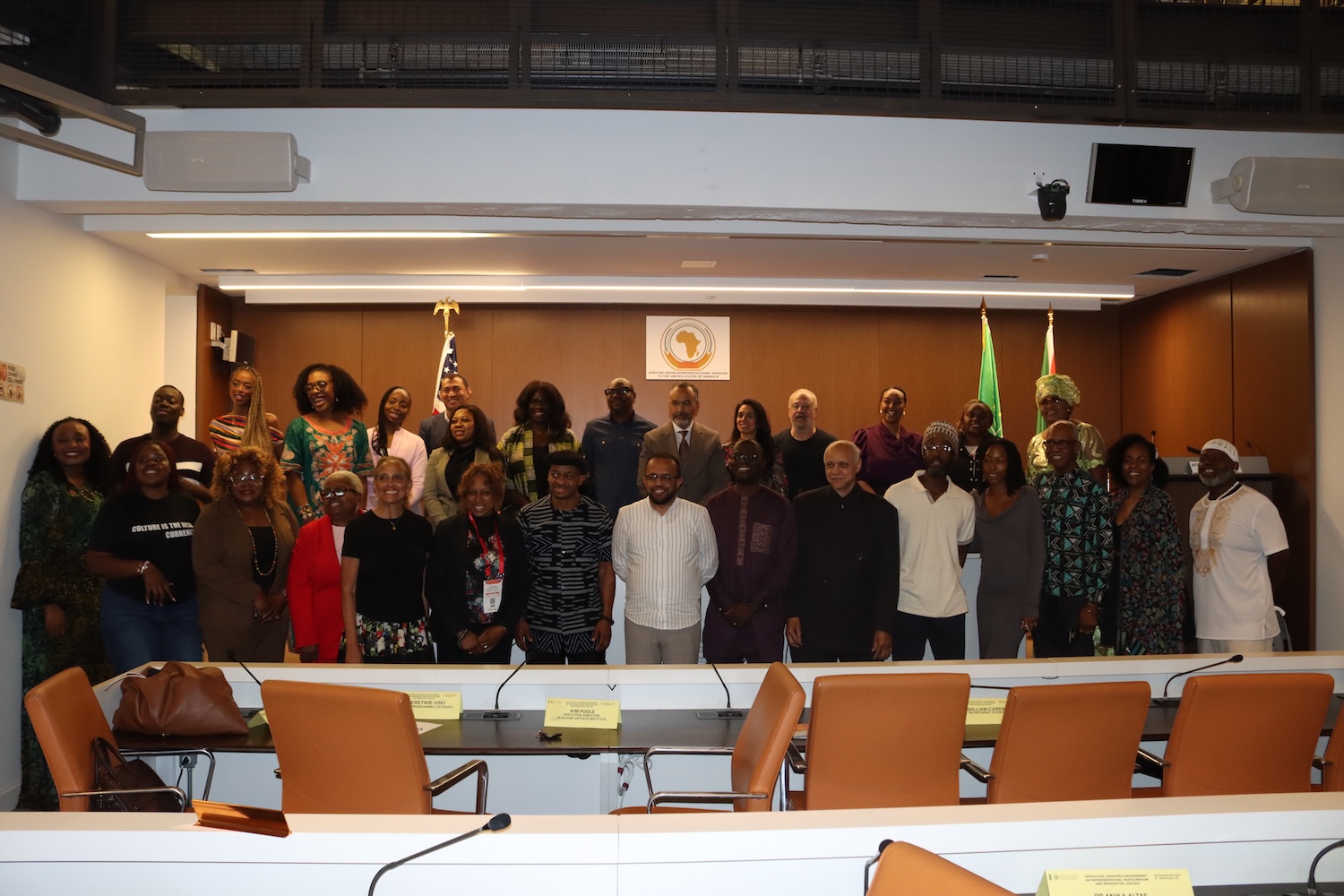
On September 18, 2026, the African Union Economic, Social and Cultural Council (AU-ECOSOCC)’s “Journey to 20 Seats: Diaspora Participation and Reparative Justice” engagement brought together stakeholders to reflect on what meaningful participation of the African Diaspora in African Union processes can look like in practice.
At the heart of the conversation was the 20 seats allocated to African Diaspora Civil Society Organisations within the 209 member ECOSOCC General Assembly, a milestone that moves diaspora engagement closer to structured and formal participation in continental affairs.
Delivering the keynote address on behalf of H.E. Ambassador Constancia Adelina Gaspar, African Union Representational Mission to the United States in Washington, D.C, Mr. Tarek Ben Youssef, Deputy Chief of Mission and Minister Plenipotentiary Hors Class, described the 20 seats as an important step in moving diaspora engagement from recognition towards formal representation.
The significance of the 20 seats was further underscored by ECOSOCC Presiding Officer, Mr. Louis Cheick Sissoko, who highlighted the opportunity to connect the experiences, knowledge and networks of African communities abroad with continental priorities.
Amb. William Carew, Head of the ECOSOCC Secretariat, reflected on the institutional journey that has brought the African Union to the point of establishing the 20 diaspora seats, tracing the process through key African Union decisions and the operationalization of the diaspora legal framework.
Amb. Carew emphasized that the 20 seats were not the destination, but the beginning of a longer journey, one that must address representation, accountability, participation and sustained engagement. He also connected diaspora representation to the African Union’s wider Decade of Reparation, highlighting the relationship between representation, historical memory, recognition, restitution, accountability and guarantees of non-repetition.
“Meaningful reparative justice requires the structured participation of the communities whose histories are at the center of these conversations,” he said.
Also speaking at the opening session, Elder Rufus T. Stevenson, a lifelong Pan-African cultural advocate, reflected on his own journey of reconnecting with Africa and embracing its ancestral legacy.
Invoking the spirit of Sankofa “reach back, fetch that spirit, and heal,” he called for greater unity between Africans on the continent and across the Diaspora.
He also highlighted the enduring relevance of the seven principles of Ma’at: truth, justice, righteousness, balance, harmony, order and reciprocity as values that can guide a more connected world.
The discussions also recalled the longstanding connections between Africans on the continent and in the Diaspora, from liberation and civil rights movements to intellectual, economic and cultural contributions to Africa’s development.
The seeds have been planted.
During the “Framing the Journey to 20 Seats” session, the conversation also explored the evolution of the AU’s engagement with the Diaspora and the significance of the 20 seats as a pathway towards more structured participation.
When ECOSOCC was established to give African citizens a voice, that vision naturally extended to Africans beyond the continent.
After extensive consultation, framework development and institutional processes, the journey is now moving from policy to practice.
As Africa and its Diaspora engage in conversations around reparative justice, development and a changing global order, the challenge and opportunity is to translate the framework into inclusive, structured and meaningful participation.
The closing session reinforced that message.
Brother Cliff Kuumba, Pan-African activist and member of the Pan-African Federalist Movement, North America, reaffirmed the importance of grassroots engagement and representative participation.
Dr. Anika Altaf, Executive Director of INCLUDE Platform, highlighted the potential of the diaspora in the leadership of ECOSOCC to create greater political participation while also drawing attention to economic participation through initiatives such as the “Coming Home to Invest: Africa Diaspora Investment Corridor.”
Closing the engagement, Mr. Tarek Ben Youssef emphasised another central message from the day: the need to move from fragmented efforts towards stronger collective action.
African Diaspora organisations, African institutions and regional bodies have an opportunity to work more closely around shared priorities and harness the Diaspora’s potential in areas including development, trade and investment.
The journey continues!
The engagement was convened by ECOSOCC and the African Union Representational Mission to the United States, with TrustAfrica, Reform Initiatives, INCLUDE Platform, Humanity United, Federation of African Journalists ( FAJ) and the Teaching Artist Institute (TAI).